Here you can find all you need to know about Iceland’s 2021 Geldingadalur volcano and more! Discover the events that took place and some amazing photos of this majestic event.
If you are looking for tour options to see the active volcano check our small group active volcano hiking tour or our private volcano hiking tour.
What makes Iceland’s geology so unique?
What I have learned over my three years living and studying in Iceland is that nature here is phenomenal and like none other in the world! Specifically, I find geology the most exciting part of the place. It is happening at an accelerated rate all around me every day. With over 30 active, but sleeping volcanoes, and rifting plate tectonics! Iceland is located on the Mid-Atlantic Ridge, where the North American and Eurasian plates are moving apart from each other at a rate of about 1 cm per year. What sets it apart from the rest of the ridge (which is all under sea level) is that in addition, there is a hot-spot (mantle plume) directly below Iceland. This has led to a significant increase in volcanic activity and aerial land growth over the last 14 million years. If you have ever been here before or if you are planning a trip here for the first time, you will be sure to see that Iceland looks almost barren. Almost like a moonscape with lots of exposed rocks and Ice with very few trees. This is because Iceland is still a very young landmass. New volcanic eruptions happen at least once in a decade here.
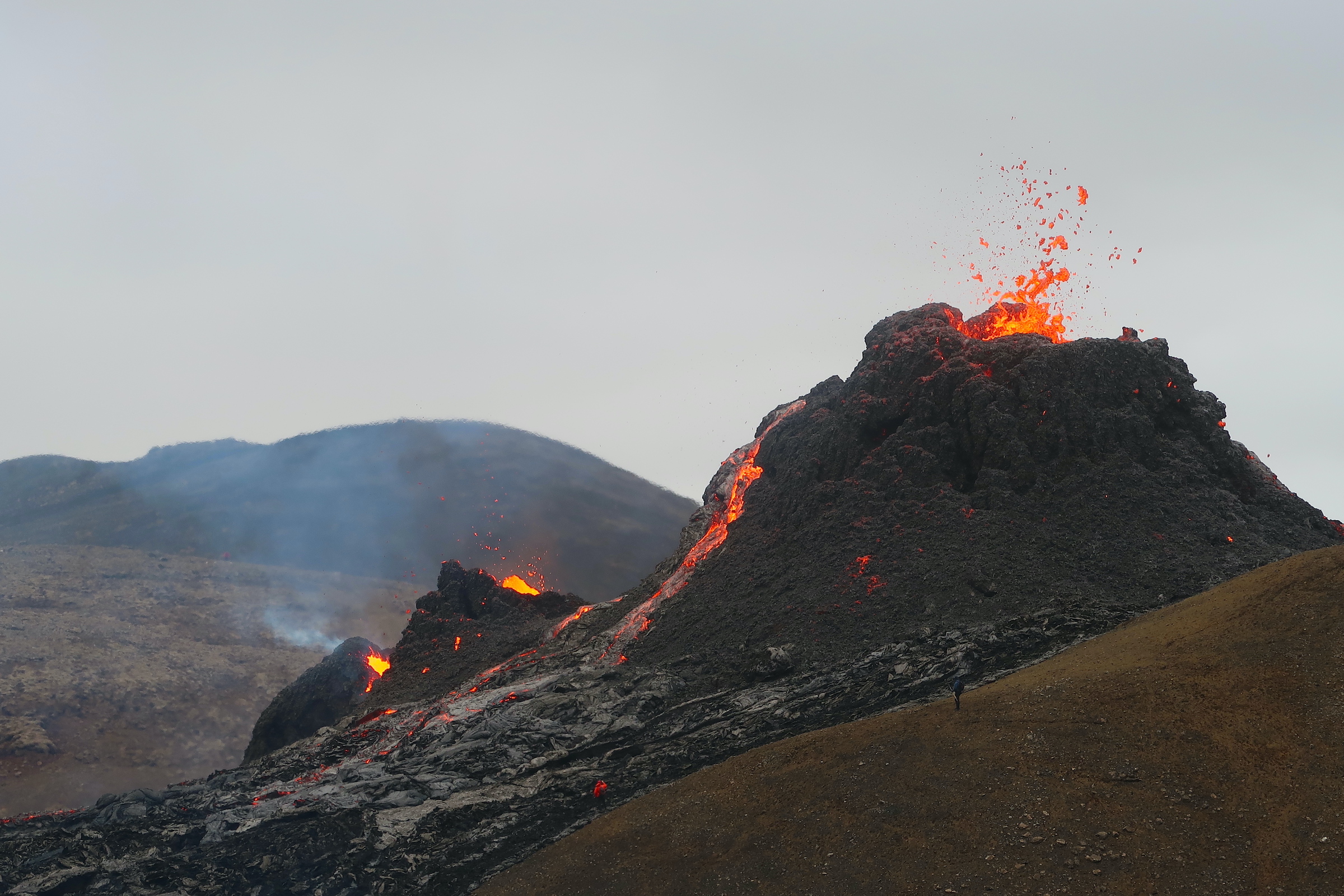
March 21st, 2021: Three cones of eruption magma along the fissure. You can see some hikers along the edge of the lava flow for scale.
The beginning of Fagradalsfjall/ Geldingardalir eruption
In late February 2021, the metropolitan area of Reykjavík was awakened by a rumble, an earthquake!!! This had me jumping out of bed and straight to my computer to check the local meteorological office webpage for the magnitude of the quake: 5.7 M! With almost three more felt in Reykjavik just that day! A swarm of over 50,000 quakes erupted in the Reykjanes Peninsula for the remainder of that month. All safe and small thankfully and caused no damage to any structures. The local geologist believed this could be a precursor to a volcanic eruption… but with no real certainty life just went on as normal.


Where is Iceland’s newest volcano located?
On March 19th, 2021, the ground tore open and a fissure eruption of 700 m (1640 ft) started to erupt. The location of this newly forming volcano is on the Reykjanes Peninsula in the Geldingadalur valley. Located between the International Airport and Reykjavík! This spectacular site is also only 13 km (8 miles) from the Blue Lagoon! This is the first volcano in this area of Iceland for over 1000 years. Located within the Fagradalsfjall geological formation, this volcanic eruption still has no official name. Both these names are freely used for the identification of the volcano. Shortly after the fissure opened the eruption started to centralize itself to smaller singular eruptive vents, kind of like a mini volcano.

People gathering around the new magma to enjoy the radiating heat and having snacks.
Driving times:
Keflavik Int. Airport – Volcano Parking – (35 km/ 21.7 miles) – approx. 30 minutes
Volcano Parking – Reykjavik (40 km /24.85 miles) – approx. 40 minutes
Blue Lagoon – Volcano Parking – (13km / 8 miles) – approx. 10 minutes
What to bring and know before the hike
I felt so lucky if one could be so excited for an eruption! A live volcano within a short 30–40-minute drive from the city and a short-day hike! I was in…all the way! Two days after it started erupting and once it was deemed safe for visitors to go, I packed up my day backpack with water, snacks, hot tea, extra warm layers, and my camera. Put on my hiking boots and set out! The thing about Iceland is the weather can change very quickly here and it is important to have warm and water-resistant layers with oneself just in case. It is important to know the wind direction and weather conditions of the location before setting out on this amazing trek. The local weather office can be found here: www.vedur.is

At first when the road to the eruption was closed for safety. We had to park our car in Grandavík, the neighboring town to the volcano, and hike 10 km (6 miles) each way to the eruption. Over 10,000 people visited that first weekend! Since then, the road has opened, and designated parking has been set up for everyone’s convenience. This has also shortened the distance to the volcano a significant amount. Now designated pathways have been marked and it is only about a 3-4 km (2-3 mile) hike in each direction. However, the volcano is ever-changing and growing! Many pathways have been covered by lava and new ones must be made. The best website for updated trails and conditions of the area is the Icelandic Association for Search and Rescue.
Gear list
- Hiking boots
- Wind and waterproof jacket
- Water
- Snacks
- Hiking poles (it really helps on steep slopes)
How has the volcano evolved with time?
The best experience of this all is seeing how this amazing event has changed with time. Many different eruptive centers have formed and cooled over the last few months. At the beginning of May, the lava started erupting like a geyser, fountaining up over 300 m (~1000ft) into the air and could be seen from Reykjavík. Now if you look in that direction you can see an everlasting volcanic plume billowing up over the peninsula. It is not known how long it will keep erupting, but the weekly study reports show that it has been erupting at a consistent rate of output magma since the beginning of the eruption with no sign of slowing down. At least at the time.

The toe (edge) of the lava flow. This is an example of a´a lava; very viscous and slow-moving. It creates these tall (meters) high walls with a crumbly front.
How should I plan my trip to the volcano?
This erupting is truly mind-blowing and I find it so amazing that it is in such a reachable location! While you can visit this site without an experienced guide, I recommend our privately guided Active Volcano Tour for the best experience. Iceland’s terrain is difficult in the best of weather. It can be challenging for those without knowledge of the surrounding area and/or if you are not a strong hiker. Guides are also great for helping you to get the best view of the volcano. In addition, the trails can be very steep and difficult.

Volcano seven weeks after it started erupting. Taken around sunset 11:00 PM (23:00) in May. This is a great example of erupting pahoehoe lava; less vicious and flows in a smooth river-like texture.
The search and rescue team has been very busy keeping people safe during all of this. They are constantly taking noxious gas; carbon dioxide, sulfur dioxide, and hydrogen sulfide readings, and making sure hazardous locations are closed off. It is important to keep these in mind while planning your trek to this phenomenal landmark. If for some reason you can’t do hiking, it is also possible to book a private volcano helicopter tour.
This volcano is truly a worldly wonder and is in such a convenient location so that everyone can have the experience of seeing it in person! Hope you all get the opportunity to visit Iceland, the land of fire and Ice!
Photos and text by Zena Severin – Geologist